

Table of Contents
Like most things in Cambodia, the currency is not particularly straightforward! In this article, we’re going to tell you everything you need to know about the currency in Cambodia in 2025.
If you’re planning to travel to Cambodia, we do recommend that you read this article very carefully. We will share some mistakes and problems that people commonly experience when it comes to using money and bank cards in Cambodia. We’ll also share some top tips on ATMs and card payments.
Making money mistakes when you’re traveling can be very stressful and demoralizing. A single moment can ruin most of your trip. We have written this article to help you avoid common mistakes. Having lived in Cambodia (we used to run a charity in Siem Reap) and visited many times over the years, we have loads of experience and top tips to share when it comes to using currency in Cambodia.
Don’t worry; this is not a boring financial article. Rather, it’s a concise and focused travel guide to help you understand how to use currency in Cambodia.
BUDGET TRAVEL IN CAMBODIA – Learn How to Travel Cambodia for $18 per day
SHOULD YOU GO TO CAMBODIA? – Is it worth visiting Cambodia? Everything you need to know
What is the official currency in Cambodia?
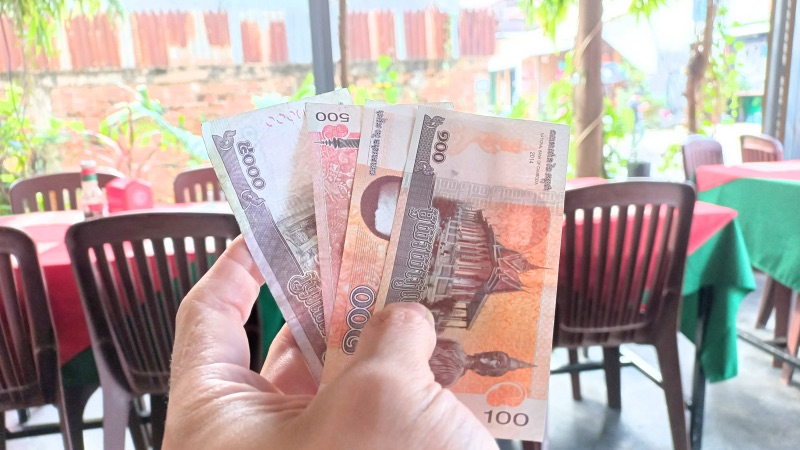
The official currency of Cambodia is the Cambodian Riel (KHR).
- $1 USD = 4,100KHR
- £1 GBP = 5,200KHR
- €1 EUR = 4,500KHR
Find the latest exchange rates on the Xe Currency Converter
However, it is not that straightforward as Cambodia essentially has a dual currency system where both Cambodian Riel and US Dollars are in circulation. Prices are commonly quoted in US dollars, and change is often given in Cambodian Riel. There is also a general trend of using US dollars in the cities and using Cambodian Riel in the villages and markets.
If you look at the exchange rates above, you will notice that the Cambodian Riel has relatively small denominations, which means the notes can have quite big values.

For example, the 10,000 Riel note is very common and is roughly equivalent to $2.50. From time to time, you may also come across the 50,000 Riel note, which is roughly equivalent to $12.50. You can also get very low-value notes. For example, 100 Riel is equivalent to $0.025 (which is 2.5 cents!).
If you’re traveling around the popular tourist destinations of Cambodia, you will always be charged in US dollars. However, you will often be given change in Cambodian Riel. It is important to have the exchange rate in your mind and don’t feel rushed or flustered. Take your time to make sure you are being given the correct change.
Is it possible to change money in Cambodia?

It is possible to change money in Cambodia. There are plenty of money exchange places around. You can normally change currency in these special shops that deal specifically with money and high-value goods. If you exchange between Dollars and Riel there should be no additional charges and you should be given the correct exchange rate.
The Khmer expression for changing money is “Som Doe Loi” (translates to Please change money). You can normally change different currencies. You can also use exchange places to get smaller US dollar notes if the cash machine dispenses high-value notes. For example, it is common for ATM machines in Cambodia to dispense $50 and $100 bills. Very few shops and restaurants will be willing to take bills with this type of value, so you will need to go to a money exchange place to get lower value bills.
TOP TIP: Always check bills carefully to make sure that they are not marked dirty, folded, or damaged. Refuse any defective notes because you will struggle to spend them.
Important things you need to know about money in Cambodia

- You may not be able to get Cambodian Riel before you arrive in Cambodia. If this is the case, don’t worry, it is fine to arrive with some US dollars which will be accepted as soon as you arrive.
- In Cambodia, you may struggle to pay with damaged, dirty, marked, or folded US dollar notes. This is especially true if you’re paying with a higher value note ($10 or above). If someone is giving you change in dollars, always check the notes carefully and do not accept any defective notes as you may struggle to pay with these later.
- Cash machines often dispense high-value US dollar notes. You will probably need to change these notes as they are unlikely to be accepted in shops, cafes, and restaurants.
- Card payments are increasingly accepted, especially in towns and cities and tourist areas. Make sure that you are using a good international bank card that does not have high fees for transactions. In some cases, you may be charged a percentage fee, so always check before you make a card payment.
- Very commonly, you will be given change for anything less than a dollar in Cambodian Riel. Although the official exchange rate is $1 = 4,100 Riel, many shops work to the exchange rate of $1 = 4,000 Riel. This makes it simple to work out your change; 1,000 Riel = $0.25 (or 25 cents).
- Cambodians are generally very honest with giving you the correct amount of change. However, it is always worth checking your change, especially when you are getting used to the dual currency system.
Don’t forget to barter!
Prices in Cambodia are often flexible, and bartering is a fun and acceptable part of Cambodian culture. It is particularly important to barter for transportation (e.g. tuk tuks and market purchases). Don’t miss our tips & tricks for bartering in Asia.
ATM Machines in Cambodia

In recent years, there has been a massive increase in the number of ATM machines available in Cambodia. If you’re traveling in the main towns and tourist areas of Cambodia, you will find plenty of cash machines around.
Internationational Cards in ATMs
Most ATM machines accept a wide range of international bank cards, including Visa cards, MasterCards, and Maestro cards. We recommend getting a good bank card that has low international charges, such as Starling bank cards. Almost all ATM machines in Cambodia have a standard charge for international transactions – normally costing $5 per transaction. It is, therefore, wise to minimize the number of times you use an ATM machine. Where possible, withdraw a great amount of money to reduce the total number of times you are charged the withdrawal fee.
Over our years of experience (living and travelling in Cambodia) we have found the Canadia ATM machines to be pretty reliable. That’s the red bank. They are also fairly widespread so you can find plenty of Canadia ATM machines around.
Problems with ATMs in Cambodia
Travelers may occasionally experience problems with the ATM machines in Cambodia. From time to time, they may not have any money to dispense, or they may have trouble accessing the internet. When you are traveling in Cambodia, we recommend withdrawing money a few days before you run out so that you don’t end up getting stuck without funds.
In one instance, we used an international bank card in an ATM in Siem Reap; the machine held onto the card for a long time and then returned the card without dispensing any money. If this happens, we recommend taking a photo of the cash machine and noting the time when this happened. We made a formal complaint to our bank, and we were told that we just needed to wait to see if the money was refunded. Fortunately, the money was refunded a couple of weeks later without needing to take any further action.
TOP TIP: the $5 transaction fee is very standard across all cash machines, and you will not be able to find ATM machines that charge less than this. However, in a few cases, you may find ATM machines that try to charge $7 for an international transaction. You won’t need to walk far to find a different ATM machine which has the standard $5 charge.
