

Table of Contents
In this article we are going to tell you how to travel with just a backpack in 2026. This may well be the most important travel article you read so PLEASE stick with us.
With increasing airline check-in baggage costs it is becoming more important than ever to travel light. Budget airlines often have extortionate fees for check in baggage. And if your bag is a little too heavy expect sky high fees. But how on earth do you get all your stuff down to just a backpack?
As the backpacking family we are very experienced traveling with just a backpack. Before we had kids we traveled very light. We now backpack full-time as a family and to be honest we don’t travel as light as we used to. However, we still travel with only what we can carry on our backs. We just have more backpacks now – which are often stuffed with snacks and nappies!
Full time backpacking as a family has taught us what we really need. It has taught us to go light and pack really well. We are very excited to share our top tips and travel hacks with you. So if you want to travel light – make sure you follow these tips.
Don’t miss our EPIC GUIDE to the cheapest countries to travel in southeast Asia
Why travel with just a backpack?

Travel with just a backpack is very liberating. The sense of freedom and adventure of knowing you have everything you need on your back is truly exhilarating.
A massive advantage to travel with just a backpack is the freedom and mobility. You can easily hop on and off buses, trains and public transport. You can easily walk around cities to find your accommodation without needing to pay over-priced taxi fees.
If you’re able to travel with just a backpack you can avoid the very expensive additional fees for check-in baggage. Everything you need is always on you. And of course there is no risk of your bag getting lost in the check in luggage process.
How big does your backpack need to be?

The longer you travel the more you will need – but not that much more. The amount of extra stuff you need doesn’t increase that much. Think about it. For a short trip you will need several changes of clothes, toiletries, tech, and a spare pair of shoes. Travel a little longer and you probably need to add a few more changes of clothes. If you travel long enough to need a load of laundry then you wont need any additional clothes.
The size of backpack that you require will depend on how you pack and what you wish to bring. These guidelines are rough guidelines for a solo traveler. Families are even more complicated as you may need to consider snacks, milk, games, nappies, books and other things. Also if you’re traveling to a cold climate you will need more size to store bulky warm clothes.
However if you are a solo backpacker and planning to pack light here is a guide to backpack sizes:
| Length of trip | Estimated capacity of bag required | Probable weight of bag (packed) |
| 2-3 days | 30 – 40 litres | 10kg |
| 5 days | 40 – 60 litres | 10 – 15kg |
| 1 week | 60 – 80 litres | 15 – 20kg |
| 2 weeks | 80 – 100 litres | 20 – 25kg |
| 1 month or more | 100 – 120 litres | 30kg |
Top tip: Realistically you may struggle to travel for more than 1 week using just a carry on bag. BUT that doesn’t mean it’s not possible. It just depends how extreme you’re willing to go.
How are bag sizes measured?

Bag capacity is measured in litres. This is a measure of the maximum volume available in a bag or backpack including all pockets and pouches. The unit litre in backpacks is the same as the unit used to measure fluids. 1 litre is 1,000 centimeters cubed.
Unfortunately, the way different backpack companies measure capacity in litres seems to vary significantly. This can make it very confusing. Two 60 litre bags from different companies may actually be
To add to the challenge – the shape of a backpack can make a big difference too. In general, tall thin backpacks are more difficult to pack and unpack compared to backpacks with a wider main compartment. The main advantage of a thin backpack is manuverability – for example, it is slightly easier to jump on crowded buses with a narrower backpack.
Looking at the capacity in litres is only a rough guide – and you also need to consider the shape and style of the backpack. If possible, we recommend looking at backpacks in store and work out which one best meets your needs.
Packing list for traveling light
- Lightweight and breathable clothing: Pack compact clothes made from lightweight, breathable fabrics like cotton or linen. Consider packing a mix of t-shirts, tank tops, shorts, and long pants.
- Small travel towel and swimming kit
- Comfortable walking shoes: You’ll likely be doing a lot of walking and exploring, so pack comfortable shoes that you can wear for extended periods of time. Sandals or flip-flops are also a good option for the beach or in areas where it’s very hot.
- Sun protection: Don’t forget to pack sunscreen, sunglasses, and a hat to protect yourself from the intense sun. A sun umbrella is also a great option if you’re sensitive to the sun or want to avoid getting too much direct exposure.
- Insect repellent: Depending on the climate don’t forget insect repellant
- Lightweight rain jacket: Pack a lightweight rain jacket that can be easily packed away when it’s not needed.
- Travel-sized toiletries: Pack travel-sized toiletries like shampoo, conditioner, soap, and toothpaste to save space in your luggage. You can also purchase these items at local stores once you arrive.
- Reusable water bottle: Staying hydrated is important, so pack a reusable water bottle that you can refill throughout the day. Consider a bottle with a filter if you’re worried about the quality of the water.
- Money belt or document holder: Pack a money belt or document holder to keep your passport, cash, and other important documents safe.
- Valuables: Phone, money, documents and other valuables – pack these carefully in a waterproof bag
- Power adapter & chargers: Pack a power adapter that will work in the region.
1 Find a backpack that is small enough for an airline carry on

If you are planning to travel with just a backpack we recommend making sure that your backpack is small enough to be an airline carry on bag. If you are not planning to fly this may not be important to you. However; if you are flying, having a single backpack that is small enough to be a carry-on can save you a lot of money. You can normally find the capacity of a backpack printed on it (either on the bag or on a label).
What are typical airline carry on bag requirements?
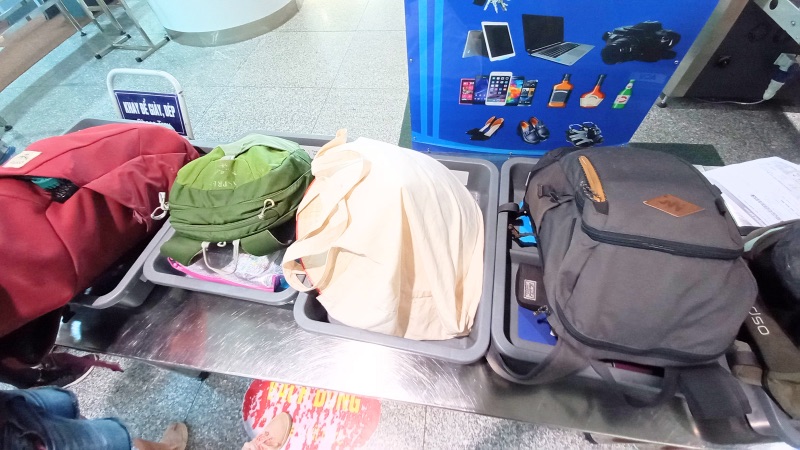
Most airlines let you bring a large carry-on bag (usually at least 55cm x 36cm x 20cm – even for budget airlines). Your carry on will probably need to be under 7 – 10kg depending on the airline. Some generous airlines let your bring more. Always check when you book.
To work out the dimensions of your backpack measure the longest rigid length of the backpack. The width and depth may vary depending how you pack.
Remember, you also need to make sure that your bag is under the carry-on weight requirements. Read on for more tips to make sure your bag is as small and light as possible. Another huge advantage of traveling with only a carry on is that the airline cannot lose your bag in the airport. Everything you need is with you all the time.
2 Make sure you leave a little bit of space in the top of your backpack

We recommend that you pack in such a way that you have a little bit of space leftover at the top of your backpack. Avoid packing your bags to the maximum capacity. as you travel and used stuff it will be stressful to have a very packed bag and zips can easily get strained and broken. Furthermore, if you travel with a stuffed bag can you will not have any room for buying additional things have you travel. there for, we recommend travelling with a little bit of space available at the top of your backpack.
3 Find a backpack with external pouches for water bottles

We recommend using a backpack with external pouches and external water bottle holders. these external pouches and water bottle holders are so useful. for a start you may want to use a water bottle that can be refilled as you travel. having an external pouch on your bag makes it super easy and convenient to grab your bottle and does not take up any additional space in your backpack. this is also a more environmentally friendly way to travel as it reduces plastic waste. Are they backpacking family We always use these external pouches for things like spare clothes, snacks, nappies, wet wipes and other things that you need to grab quickly with kids.
4 Have an additional fabric bag

We strongly recommend traveling with an additional fabric bag. Something small and compact. Try and find a bag that can comfortably fit over your shoulder and can also be rolled down and packed tightly into a spare pocket inside your backpack. A spare fabric bag comes in handy in so many situations. For example, when we’re going to the market it’s awesome to have a reusable bag for fruits and vegetables. We also find these fabric bags are very useful for flights. You can often put spare clothes and other bits and pieces inside the bag and airlines don’t seem to mind.
5 Use a dry sack inside your backpack
We recommend having at least one dry sack inside your backpack. Yes – we’re talking about the roll down sacks that you use for watersports. Use a dry sack to store valuable items such as money, passport and technology. Firstly, this will keep all of your valuable stuff dry if you get caught out in a heavy rainstorm. Secondly, using a dry sack provides an extra layer of protection from thieves and pickpockets. We have found this to be a very effective way to travel and pack our valuables on the road.
6 Use a document wallet or holder
We find it very useful to travel with a plastic wallet for documents, passport and other important things. This stops all of your most important documents from getting spread around your backpack and potentially going missing. A plastic zip wallet provides a dry and safe place for things like passports, certificates, boarding passes, travel insurance documents, bank cards and much more. This can potentially slide into a dry sack or down a laptop pouch at the back of your backpack. A document wallet is especially useful when you’re traveling through airports and can’t find anywhere to pop your passports and other documents.
7 Plan to do your laundry as you travel
If you are planning to travel with just a backpack we recommend planning to do some laundry on your trip. This may look different in different countries. For example, in some countries it is viable to use launderette and self service washing machines. Southeast Asia is generally great for cheap laundry on the go (except Singapore which is expensive). In other countries you may need to do laundry in a sink. If you’re doing laundry this way – do little and often. For a longer trip, we recommend having around 5 – 7 changes of clothes. Plan to do your laundry after around 5 days (and it should hopefully be ready by day 7 before you run out of clothes!). If you can make time and space to do laundry this often, you wont need to carry many clothes.
8 Minimize the number of shoes you take

One of the biggest items that people carry when they travel are spare shoes. Not only are shoes bulky they also add quite a bit of weight to your baggage. Therefore, if possible we recommend minimizing the number of shoes that you take. For traveling in a hot climate we recommend using flip-flops or sandals as your main shoe and possibly have a spare pair of trainers in case you need to trek or play sports. We don’t recommend traveling without trainers – you may be prohibited from some activities without appropriate footwear. For example, zip lines, high ropes courses and some guided treks require that you have proper shoes.
9 Two birds with one stone
A clever way to make sure that you pack as light as possible is to look for ways that your kit can double up. Here are some examples of where your kit can serve different purposes. A small blanket can be used as a travel towel, a sarong, or a beach mat. Soap can be used as shaving foam (seriously this actually works really well!) Most phones normally have an inbuilt torch. Use a rolled up hoodie as a pillow for buses, trains and planes. Use socks to store small items like cameras. Find an adaptor plug with inbuilt USB ports so you can charge everything together.
10 Take travel size bottles
If possible get hold of small travel size bottles of toiletries. This is especially important if you are planning to fly with a carry-on and no check-in luggage. Remember that most airport security checks have a fluid limit of 100ml. You can normally pick up small cheap travel size bottles from shops and convenience stores.
11 Remember that you can buy things on the road

Travel can feel a little scary. Over-preparing can lead to over-packing. If you forget something you can buy most things on the road. Actually buying locally can reduce the size and weight of your baggage for travel. Why not wait to buy some of your toiletries as you travel? Or bring less clothes and buy clothes as you travel? If you are from Europe or the USA and you’re traveling Asia, toiletries and clothes will probably be cheaper overseas. The one exception is suncream. In some countries suncream can be very expensive. Some of the best clothing and kit that we own was purchased whilst we were traveling. And remember a little bit of free space at the top of your backpack will go a long way.
12 Minimize the number of thick warm layers that you bring

If you are traveling to a warm climate keep thick warm layers to a minimum. We tend to travel southeast asia with one thicker top or hoodie. It does come in useful occasionally – e.g. for a cold A.C. bus, in a shopping mall or an airport. But try to stick to one warm layer. If you bring some trousers go for a thin and lightweight material so they can roll down to be very small. We don’t recommend jeans (unless they are small shorts) as this material is bulk and relatively heavy. Keep all your clothes as small and
13 Use stuff sacks

We recommend using stuff sacks inside your backpack. You may see articles advising packing cubes. Packing cubes are great for suitcases that are cube shaped. But packing cubes aren’t designed for backpacks. So grab some thin stuff sacks for clothes. This is a great way to organize your backpack and compress clothes down. Stuff sacks are particularly useful if you’re sharing backpack space with another traveler (e.g. a partner or family). This allows you to pack and grab clothes easily. We also recommend having small bags for things like charger and adaptor plugs. The more organized your backpack, the safer your kit and the smoother your travel.
14 find a backpack with external straps
External straps? This isn’t a feature that people pay much attention to. But external straps on a backpack are very useful. Firstly if you have packed light you can use external straps to tighten up your backpack and make it more compact. In some situations you can use external straps to add extra things to the backpack. For example we have traveled for over a year with a small skateboard strapped to the back of one of our backpacks. Or what happens if your hand washed t-shirt hasn’t quite dried before you need to check out of your hostel? Just strap it to the outside of your backpack to finish drying. External straps are super handy.
15 Make the most of every bit of space in your backpack

This may sound obvious. But it’s worth a moment to think about. Watch out for gaps in your backpack – little bits of space that can be filled. For example, if you have some trainers in your backpack, stuff some clothes inside the trainers. Small kids shoes can actually fit inside papa shoes. Watch out for cases with small gaps. It could be a camera case or a drone case. Stick your SD cards or headphones into small gaps inside cases.
