

If you are planning to visit Petra in 2025, it is essential to prepare well for your trip. One of our big questions before we visited Petra is whether it is a religious site. It is particularly important to understand the cultural rules and expectations when you are visiting religious sites. So, is Petra considered a religious site? And if so, are there any strict rules and regulations that you need to follow?
In this article, we are going to share our firsthand experience of Petra along with some insights into Jordanian culture. This will help you get to grips with Petra before you visit and prepare well. We absolutely loved exploring Petra, and a little bit of knowledge and background can really help you make the most of your trip.
We have also shared a list of cultural tips which should give you some insight into the real local culture on the ground at Petra and better understand what to expect.
Don’t miss our FULL and In-Depth Visitors Guide to Petra
Religious History of Petra

You probably won’t be surprised to learn that Petra has a rich, complex, and fascinating story. Petra is an ancient city carved into the rose-red cliffs of southern Jordan. Its history is intertwined with a fascinating blend of cultural influences and belief systems. The city was originally established by the Nabataeans, an Arab people, in the 4th century BC. Their religion, which was primarily polytheistic, worshiped deities associated with nature and the cosmos. The most prominent of these deities was Dushara, often depicted as a bearded god riding a camel, and Al-Uzza, a goddess of fertility and protection.
As Petra grew in prominence and prosperity, it became a vital hub for trade routes in the ancient world. The city’s religious landscape evolved over time as it came into contact with various cultures, including Hellenistic, Roman, and later, Christian influences. In the 1st century AD, during the Roman period, the city saw the construction of grand temples, altars, and tombs that reflected a syncretism of local and Roman religious practices.
The spread of Christianity in the region during the 3rd and 4th centuries AD had a profound impact on Petra. Many of the Nabataean tombs were repurposed as Christian places of worship, and churches were constructed within the city. Petra’s religious significance shifted as it embraced Christianity, and the city continued to thrive until a series of natural disasters and political changes led to its decline and abandonment.
Significance of Petra Now

Is Petra now considered to be a religious site? The quick answer is “no.” The state religion in Jordan is Islam, and it is a conservative Muslim country. The Islamic culture of Jordan is very prominent, and the Petra archaeological site is not considered to have any religious significance to Muslims. Since Petra is not deemed to be a religious site, you don’t need to worry about any special religious rules, requirements, or regulations when you visit.
However, Petra is held in high respect by locals as one of their most significant attractions. Remember, Petra is one of the wonders of the world and is also a UNESCO World Heritage site. So when you visit Petra, it is important to recognize that you are visiting a very significant and important attraction in Jordan. Therefore, it is important to act respectfully, especially avoiding causing damage. It is not possible to enter the Treasury itself. This is to conserve the Treasury and prevent damage.
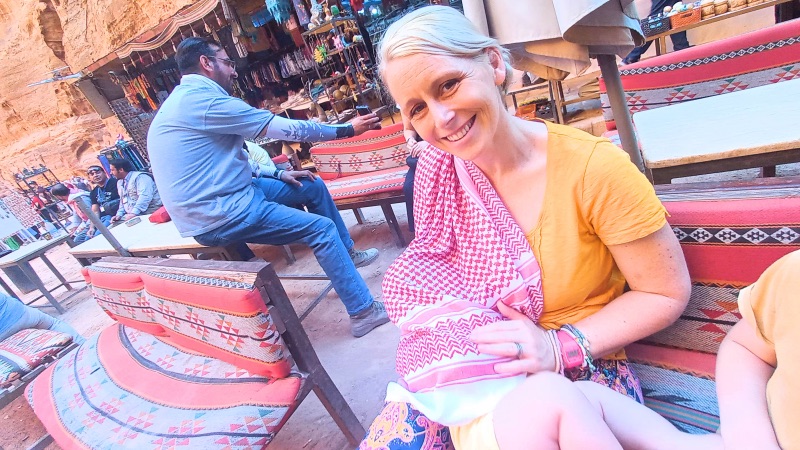
When you are visiting Petra, it is also important to recognize that you are still very much in Jordan, and it is important to be sensitive to the Jordanian culture in general. It is important to dress conservatively, keeping knees and shoulders covered. Furthermore, if you’re traveling with a breastfeeding infant, it is not culturally appropriate to breastfeed in public unless you are using a feeding scarf to cover your baby.
There is also a fascinating subculture at Petra. The locals are very warm, welcoming, and friendly, but they are also very keen to make business. Around Petra, there are many locals selling gifts, food, drinks, and offering tours and animal rides. It can be quite an intense and challenging area. What’s more, the locals can be very intense, charging foreigners to visit viewpoints for photography.
Some cultural tips and advice for visiting Petra

- Dress conservatively to show respect for the general culture. We recommend keeping your shoulders and knees covered, avoiding low-cut tops.
- Try to be aware of people’s space and avoid photobombing people if possible.
- Bartering is acceptable, but keep it friendly and positive.
- If the locals are intense, avoid being rude or aggressive in return. We recommend that you keep your interactions friendly and firm. Don’t feel like you need to buy something just because you have been talking to someone.
- Always agree on all the details before you do buy something. For example, if you are taking a local guide, make sure you agree on the length of time and the attractions that you hope to see.
- If a local has offered a service, they may hope for a tip. This is not part of traditional Jordanian culture. It can be a nice gesture to give a tip, but don’t feel manipulated or pressured into giving more than you feel comfortable with.
