
Table of Contents
In this article, we are going to share an independent, self-guided Jerusalem walking tour for 2025. The aim of this walking tour is to help you see all of the best attractions around the old city. We have designed a route that maximises attractions and sights but minimises your distance.
Important: There are a few challenges walking around Jerusalem – so please do read this article carefully.
We absolutely loved exploring Jeursalem and we have designed this walking tour to help share our highlights. This saying is so true “If we can do it, so can you”. And we want to show you how to do it step-by-step.
We have tried to make this walking tour as helpful as possible, including a map, a route, and fascinating things that you can see along the way.
Looking for more inspo? Don’t miss these Amazing things to do in Jerusalem
This walking tour aims to hit all of the “big must-see” attractions – so that you don’t miss any of the BEST bits. We have included an optional detour up the mount of Olives (you may want to time this with sunset). We have also included the route of the Via Dolorosa. As a self-guided tour you will need to navigate yourself. Take a print screen of our map or get some data on the go so that you can navigate (remember to enable GPS location on your phone to help you navigate).
Staying for a few days? Don’t miss our in depth 3 day Jerusalem Itinerary
Map of a free Jerusalem old city walking tour
Summary of this Jerusalem walking tour
| Summary | Total distance walked | |
| 1 The Damascus Gate | Scenic gate with markets and local street food on the north of the old city. Good transport connections & accommodation. | 0km |
| 2 The Garden Tomb | Scenic, tranquil garden. One of the possible sites of the crucifixion and burial of Jesus. Free to visit. Open from 8.30am – 5pm.August closed Sunday and Mondays.Other months only closed Sunday. | 0.3km |
| 3 Hidme Falafel | Small street side falafel stall selling fresh Falafel sandwiches 12NIS. | 0.7km |
| 4 The Church of the Holy Sepulchre | Impressive and beautiful church marking the traditional site of the crucifixion and burial of Jesus. Can be busy later in the day and in high season. Free to visit. | 1.1km |
| 5 Muristan Market | Beautiful old city market. | 1.2km |
| 6 The Tower of David | Impressive historic tower located by Jaffa Gate. 50NIS to visit. | 1.5km |
| 7 Visit Teddy’s Park | Lovely green park with water fountains. Great place for kids to cool off and play. | 1.8km |
| 8 Western Wall | Very significant site for Jews. The only remaining wall from the Second Jewish temple period. Free to visit. Visitors are welcome. | 2.6km |
| 9 Hezekiah’s tunnel | Fascinating historic underground water tunnel. Adult ticket: 28NIS (around £6 or $8)Child ticket (5 – 18 years old): 14NIS (around £3 or $4) Under 5 year old FREE | 3.1km |
| 10 Garden of Gethsemane | Can take a bus to get here. Beautiful olive tree garden at the base of the mount of Olives. | 4.1km |
| 11 The Mount of Olives (optional) | Beautiful hill with views over Jerusalem. Great spot for sunset. Site of the ascension of Jesus. | 4.7km |
| 12 Walk the Via Dolorosa | The route Jesus took carrying the cross to his crucifixion and burial site finishing at the Church of the Holy Sepulchre. | 5.9km |
How far is this walking tour?
It is worth recognizing that this is a pretty long walking tour, and there are some uphill sections, especially from the City of David back to the Jerusalem old city, and also up the Mount of Olives. An average person may find this walking tour quite challenging for one day.
Total distance (excluding the Mount of Olives): 4.7 km
Total distance (including the Mount of Olives): 5.9 km
Approximate time: 4 – 6 hours (depending on stops)
Here are some ways that you can make this walking tour a little bit easier. We especially recommend this if you’re planning to do the walking tour with young kids. Firstly, some sections can be done by bus or taxi. When we share our full and in-depth description of the route, we will also indicate which sections might be done by bus or taxi. Another way to make this walking tour more approachable is to divide it into two separate days. This is a great idea if you have a little longer in Jerusalem (a 2-3 km loop on each day).
Why take a Jerusalem walking tour?

If you’re planning to explore Jerusalem, then we highly recommend taking a Jerusalem walking tour, whether you follow the route that we have suggested in this article or book yourself onto a guided tour. Taking a Jerusalem walking tour is a perfect way to see, smell, feel, and experience this unique and rich ancient city. Taking a Jerusalem walking tour allows you to see things that you may miss if you were to zip around in a taxi. What’s more, there are many parts of the Jerusalem old city which are inaccessible to cars, taxis, and bikes. Therefore, much of the old city, the only way to explore is to take a walking tour. We really enjoyed walking around the Jerusalem Old City. It is genuinely a multi-sensory experience with markets, food stalls, spice shops, and plenty of locals trying to sell you everything under the sun.
Is it better to do an independent walking tour or to pay for a guided tour?

Whether you prefer to take an independent self-guided tour or pay for a guided tour is a matter of personal preference. There are advantages to each and disadvantages to each. Personally, we love exploring new places on our own and at our own pace. However, being part of a guided tour can be a lot of fun. You don’t need to worry about navigation or getting lost, and you can just listen to your tour guide explaining and discussing the fascinating history of the places that you are exploring.
Here is a summary of the advantages and disadvantages of each type of walking tour:
| Self-guided walking tour | Tour with a local tour guide |
| Free Go at your own pace Need to research Need to navigate Find your own special places | Expensive Go at the pace of your group Local expertise and experience Your guide will navigate Find local secrets and hidden gems |
Top tips if you are doing a Jerusalem walking tour

Here are a few top tips and ideas to help you make the most of a Jerusalem walking tour:
1 Wear good shoes
Firstly, we recommend that you wear a good pair of shoes. There is a lot of walking, which includes some uphill sections, and having a comfortable pair of walking shoes is highly recommended. The best type of shoes for exploring the Jerusalem Old City would be a pair of trainers. Ensure you wear comfortable socks too. This will help prevent rubbing or blisters.
2 Bring sun protection
Much of the Jerusalem old city is actually in shade and pretty cool throughout the day. However, there are some sections of this Jerusalem walking tour which are relatively exposed. If you hit these sections during the heat of the day, we recommend considering sun protection. We have found a small umbrella is an ideal way to keep ourselves and our kids covered from the Sun. However, you may also consider sun hats. We also recommend wearing a high Factor Sun cream, especially if you’re planning to explore Jerusalem during the summer months of July and August.
3 Bring a water bottle
We strongly recommend that you bring a water bottle on your Jerusalem walking tour. There are shops throughout this route selling water, and in some places, you can find water fountains, so you can top up a water bottle. The hot, dry Jerusalem climate can be very dehydrating, so make sure you always have some water in your bag.
4 Don’t feel like you need to stop for every conversation
The local culture in Jerusalem is very friendly and welcoming. As you walk around the Jerusalem Old City, you will find that locals will want to start conversations with you, find out where you are from, and have a general chat. In many cases, they are trying to get you to come into their shop or sell you something. We have found the best way to respond to this is to be polite and friendly but keep moving. Just because someone is starting a conversation with you doesn’t mean that you need to stop, and it certainly doesn’t mean that you need to buy something. The locals in Jerusalem won’t be offended if you smile and keep moving.
5 Barter for a fair price
If you’re planning to buy anything from the market stalls, especially gifts or clothing, then we highly recommend that you barter to get a fair price. Remember that you can often find the same products at many different stores, so if you’re not happy with the price, then just keep looking. We have found the most effective way to barter is to be positive and friendly, build a rapport with someone, but not feel like you need to buy it if you are unhappy with the price.
Jerusalem Walking Tour – In-Depth Guide
You can start this Jerusalem walking tour at any point on the map. However, for convenience, we have decided to start at the Damascus gate since there is a lot of accommodation here. You’re likely to get dropped off at this location if you’re traveling to the Old City from other locations in Jerusalem.
1 The Damascus Gate

The Damascus gate is a beautiful bustling Old City Gate situated on the north wall of the old city. There are plenty of Market stalls in this area, and local food is available. Also, there are also a couple of bus stations around here, and this is a great place to grab a taxi. There is also some great accommodation in the Damascus gate area. In our opinion, the Damascus gate is a wonderful place to start your walking tour in the morning. This area has a lovely tranquil feel. From the Damascus gate, you can take a short stroll North up Nablus Road to visit the beautiful Garden Tomb which opens around 8:30 a.m.
2 The Garden Tomb
Don’t miss our FULL guide for the Garden Tomb
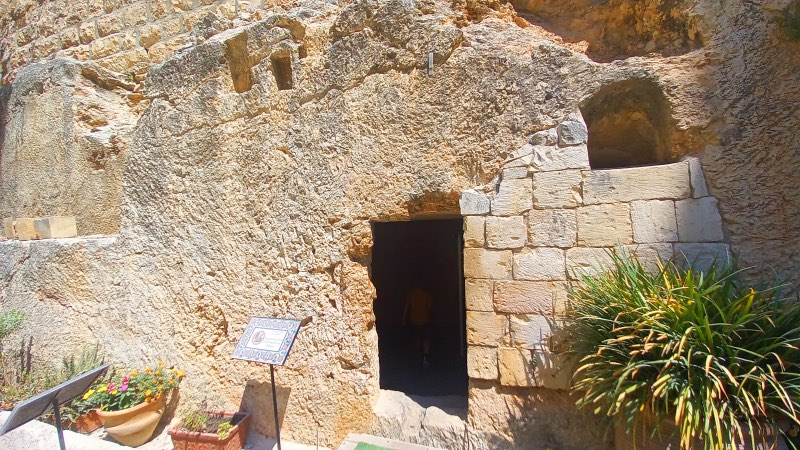
Visiting the garden tomb with genuinely one of our highlights of our time in Jerusalem, and we highly recommend that you stop here on your walking tour. It is free to enter the garden tomb, and that is likely to take at least 30 minutes to explore and take in this beautiful attraction. The garden tomb has beautiful paths leading through a very well-kept Garden. You can see the Golgotha Cliffs, which some people believe mark the crucifixion site of Jesus. You can also visit the tomb itself and step inside the tomb to see the place where people think that Jesus was laid to rest. The garden tomb has a beautiful tranquil ambiance, and there is also a lovely gift shop. After exploring the garden tomb, head back down to the Damascus gate, walk through the gate, and start walking South into the old city.
Open from 8.30am – 5pm.
August closed Sunday and Mondays.
Other months only closed Sunday.
3 Hidme Falafel

After you walk through the Damascus gate, you will see some Market stalls, and the path leads down a small hill to a fork Junction, and you will see a small Street side Falafel shop. They sell fresh local Falafel sandwiches, which are garnished with heaps of salad and sauces. If you’re already starting to work up an appetite, then we recommend stopping here to sample some of the best falafel in The Old City.

Being a small Street side stall, the quality is high, and the prices are low. It costs 12NIS (£2.50 or $3) for a Falafel Sandwich (which is great for Jerusalem). From here, take the road to the right (Beit Habad Street) and walk towards the Church of the Holy Sepulcher.
4 The Church of the Holy Sepulcher

We highly recommend stopping at the Church of the Holy Sepulcher. This is the other main contender for the crucifixion and burial site of Jesus. The Church of the Holy Sepulcher is a very impressive, large, and Grand church with many sanctuaries, altars, and beautiful historical artwork. In the morning, the Church of the Holy Sepulcher is relatively quiet, and this is a lovely time to explore. However, it can get very busy later in the day, and it can be quite an intense experience. Just as you head into the entrance of the Church of the Holy Sepulcher, you will see a stone slab on which they believe Jesus was laid after he was crucified.

To the right, you will see some steps, and if you go up the steps, you can see an altar which stands at the place they believe Jesus was crucified. This is called the place of Golgotha. If you head back down the steps and walk around the corridors of the church, you can find the tomb where they believe Jesus was laid to rest. During the day, it is possible to enter The Chapel at the tomb, light a candle, and place your hand on the stone slab that covers the tomb. If you wish to do this, you need to be prepared to queue for at least 20 minutes, and during busy seasons, it may take much longer than this. The Church of the Holy Sepulcher is a relatively conservative church, so we recommend dressing modestly and respectfully (this applies to both men and women).
5 Muristan Market

After you exit from the Church of the Holy Sepulcher, head south to the Muristan Market. This is a beautiful and historic Market selling a range of street food, gifts, clothing, and there are also some more upmarket restaurants in this area. On average, prices in this market are a little bit higher than other places around Jerusalem, and you do need to be willing to barter if you want to get a fair price. Even if you are not buying something, this is a very beautiful walk, and if you follow the street through the market, you can get to the Tower of David.
6 The Tower of David

After you’ve explored the market, you can see the Tower of David, which is situated at the Jaffa gate on the west side of the Jerusalem Old City. If you’re interested in learning more about the history of the old city, it costs 50NIS (around £10 or $12) for an adult ticket to explore the Tower of David. You can get very beautiful views of the Tower of David from the streets around this area. The Tower of David is also surrounded by plenty of small shops, Market Restaurants, and Street Food.
7 Visit Teddy’s Park

If you have the energy, and especially if you are traveling with kids, we highly recommend walking across the road at Jaffa gate to see Teddy’s Park. This is a beautiful Green Park situated just outside the west of the old city wall. This park has water fountains which are beautiful for cooling off, and kids come here to play. Our kids really enjoyed playing in these fountains.
There are also grass slopes next to the Fountain which allow you to sit back and supervise your kids while they play. The water fountains run for 30 minutes every 30 minutes, so if the water is not running when you arrive, you will not need to wait for more than half an hour before they come on again. If you plan to do this with your kids, we do recommend bringing a towel and a change of clothes and remember sun protection because this is a pretty exposed location.
8 Western Wall

After spending some time at Teddy’s Park, head back into the old city through the Jaffa gate and walk East, following the route until you reach the Western Wall. The Western Wall is a very interesting and unique part of the Jerusalem old city. This is one of the most revered and important sites for Jews. The Western Wall is the only remaining part of the Jewish temple dating back to the second temple period. This part of the temple wall was fought to be built by Herod the Great around 19 B.C.
Although this is a very important and significant site for Jews, we found the Jewish people here to be very friendly and welcoming, and we are allowed to enter the prayer and worship areas. We even visited with our kids, and our kids were welcome in the worship area too. It is free to enter the Western Wall. In order to enter the Western Wall, you do need to go through a security checkpoint, which involves putting any bags or belongings through an X-ray scanner.
9 Hezekiah’s Tunnel

After exploring the Western Wall, walk south until you reach the city of David. The city of David is a national park situated to the south of the Jerusalem Old City. You can buy tickets for Hezekiah’s tunnel at the city of David Visitor Center. Once you have purchased your ticket, you need to take a 5-minute walk down the hill following the signs to reach the entrance of Hezekiah’s tunnel. There is someone who will check your ticket, and then you can follow the route down through Warren’s shaft until you reach the entrance of the water tunnel.

If you don’t fancy getting wet, there is no alternative route called the Canaanite tunnel, and there are clear signs in English to help you find the right way. Hezekiah’s tunnel is a long and fascinating water tunnel, 533m, and over 2,700 years old. This fascinating water supply has a long history and supplied the city with water in times of siege. You can walk all of the way through the tunnel. There are a couple of sections of deep water at the start and end. Most of the walk through the tunnel the water is around ankle deep.
- Adult ticket: 28NIS (around £6 or $8)
- Child ticket (5 – 18 years old): 14NIS (around £3 or $4)
- Under 5 year old FREE
Top tip
This is not suitable for anyone with mobility issues. In our opinion, this is one of the best activities in Jerusalem for kids. When you reach the end of the tunnel, you can either take a shuttle bus back up to the visitor center for 7NIS. Alternatively, there is a local bus stop, and you can jump on the bus all the way back up to the Jerusalem Old City (bus 286 goes back up the hill, and you can take this bus all the way to Lion’s Gate, which is the next stop on this walking tour).
10 Garden of Gethsemane

The Garden of Gethsemane is a very peaceful and beautiful garden. Although it is not possible to walk through the trees, there is a small path around the circumference of the garden allowing you to immerse yourself in the beauty and atmosphere of this unique place. Some of the olive trees in this preserved garden date back to 1092. It is free to visit the Garden of Gethsemane.
- FREE entry
- Summer (April – September): 8 am – 6 pm
- Winter (October – March): 8 am – 5 pm
11 Visit the Mount of Olives
Check out our full visitors guide to the Mount of Olives

After visiting the Garden of Gethsemane, there is an optional detour where you can walk up the Mount of Olives. This is an amazing place to get a view over the Jerusalem Old City, and it is also a wonderful place to go and see the sunset. The walk from Gethsemane to the peak of the Mount of Olives is around 600 m, and the path leads up a relatively steep hill, so we only recommend doing this if you have some spare energy. There is no alternative route where you can get a bus to the peak of the Mount of Olives if you’re running out of energy.
You can take buses to the peak of the Mount of Olives from Shamouil Road at the northeast corner of the Old City (we marked the location of the bus stop on the map). Buses cost 5.5NIS per person (roughly £1 or $1.20). Bus 275 or 255 goes up Mount of Olives (255 follows a less direct route and 275 follows a more direct route). Alternatively, a taxi up the Mount of Olives is likely to cost around 20NIS – 30NIS (roughly £4 – £6 or $5 – $8).
12 Walk the Via Dolorosa

After visiting the Garden of Gethsemane, we recommend heading back into the old city through the Lions Gate on the East Wall. If you follow the road, you join the route of the Via Dolorosa (Latin for “Sorrowful Way”). This is thought to be the route that Jesus walked to reach the point of Golgotha where he was crucified. Along the Route, you can see 14 different stations, which represent different events that occurred on Jesus’s walk.
The Via Dolorosa officially starts close to the Church of condemnation at the Umariya Elementary School, near the location of the former Antonia Fortress. Each of the different stations along the walk has an information sign so that you can learn more about the history and significance of each point of this route. We have marked on the route on the map, which leads all the way back to the Church of the Holy Sepulchre. This also marks the end of a Jerusalem walking tour. From here, you can either head north back to the Damascus gate or go back to your accommodation by the most convenient route.
What do you need to pack for a walking tour of Jerusalem?
Here is a short packing list to help you prepare for your Jerusalem walking tour. This is not a comprehensive list, but rather a list of important things to help you get started:
- Sunglasses
- Comfortable shoes
- Loose light clothing
- Scarf (for temples and churches)
- Water bottle
- Small day bag
- Sun protection (umbrella, sunscreen, or hats)
- Phone with offline maps or mobile data
- Some cash (be careful of your wallet or purse – don’t carry too much cash)
What is the best time to do a walking tour around Jerusalem?

If you plan to do a Jerusalem walking tour, we recommend starting nice and early in the morning. Even during the summer, the mornings are relatively cool, especially if you’re starting around 6:00 a.m. or 7:00 a.m. The old town is also particularly tranquil and beautiful at this time, and you will find certain places are already open.
For example, the Church of the Holy Sepulcher has Mass services at around 7am or 8am It is worth mentioning that many of the shops and Market stalls do not open till around 8am or 9am, and some of the attractions are not open till around 8am. or 9am. We would also add that it is not too hot in The Old City due to the shade of the buildings. We found that many of the old city streets were shaded for most of the day, even during August.
In terms of the time of year, Jerusalem is relatively quiet during the summer months of July and August. During these months, the temperature is very high. Most days there’s a clear blue sky, and temperatures reach to the high 30s. Alternatively, the Jerusalem High season is between the month of September and November, and it is particularly busy in these months. The weather is very nice, and the average temperatures are lower than the summer months. There is a bit of a travel boom in December (Christmas holidays). In these months, the average temperatures are fairly cold, and Jerusalem can experience rainfall as well.
Is it safe to explore Jerusalem independently by foot?
IMPORTANT UPDATE OCTOBER 2023: We are very sad to learn of the problems in Israel. The FCO currently advises against all but essential travel to Israel including Jerusalem and Tel Aviv. They also advise against all travel in Gaza and the South and in the border regions with Lebanon and Syria in the North. Remember if you travel against FCO advice you will not be covered by your travel insurance policy. If you are currently in these regions follow consulate advice and take care. Keep your eye on the FCO website for updates.

Before we get specific about Jerusalem, it’s important to recognize that any travel experience has inherent risks, and it’s important to research and be aware of the risks before you travel. We have found the information on the FCO website to be particularly helpful and relevant, especially when it comes to advice on safe travel and current affairs.
Israel has a long history of political instability and conflict. However, the Jerusalem Old City is relatively stable, and in general, it is safe to walk around. This being said, you do need to be careful and vigilant. There have been some cases of political instability and violence in Jerusalem in the past, and it is possible that such incidents may occur again. As such, we do recommend that you do your own research before traveling to Jerusalem and monitor the local news to be aware of any political instability.
It is also possible that there may be protests and demonstrations during your time in Jerusalem, particularly around sensitive political issues. In such cases, we recommend avoiding these areas and demonstrations and being cautious about attending public events.
In terms of crime, Jerusalem is relatively safe for tourists. The Old City is well-patrolled by police. However, like in any major city, there is always the potential for petty crimes such as pickpocketing and scams targeting tourists. To minimize the risk of becoming a victim of crime, make sure you keep an eye on your belongings, avoid displaying valuable items, and be aware of your surroundings.
