
Table of Contents
In this Angkor Wat guide, we will tell you everything you need to know to plan your trip in 2025.
We have lived in Siem Reap and visited Angkor Wat many times over the years. With our in-depth local knowledge, we have learned some clever local tips and tricks to make the most of your visit to Angkor Wat.
Angkor Wat is intense, challenging, and truly epic. A little research is essential to ensuring a memorable experience. So, if you’re hoping to plan an amazing trip, please do read this article carefully.
In this Angkor Wat Guide, we will show you how to avoid the crowds, find hidden gems, and the best way to get your tickets (avoiding the queues and even getting some extra time in Angkor Wat).
The tips that we will share in this article are genuinely not available anywhere else online. We are sharing our own unique experience and tips. We will also share plenty of practical information such as prices, locations, opening times, and ticket rules.
GET INSPIRED – Don’t miss the FULL GUIDE to the Best Things to do in Siem Reap
GET PREPARED – Check out this Full and In-depth 3 day itinerary for Siem Reap
VISITING WITH KIDS? – Find out more about Visiting Angkor Wat with Kids
Is it worth visiting Angkor Wat?

If you are visiting Cambodia, then a trip to Angkor Wat should definitely be at the top of your list. This is one of the most significant and impressive attractions in Cambodia and perhaps in the region. Angkor Wat is not just one single temple but an entire complex of temples, lakes, waterways, and buildings (it was originally built as a city rather than a single temple). There really is a lot to see and do in the area.
The temple ruins are very impressive and atmospheric. If you love photography, you will absolutely love Angkor Wat. Of course, there are the classic photo spots in front of the main temple at sunrise, but there are also lots of other hidden gems around the Angkor Wat complex. If you love photography, you could easily spend a full day here taking unique and beautiful snaps.
Even if you’re not interested in photography, exploring Angkor Wat is a lot of fun. You can get lost in a maze of small pathways leading through temples and between ruins. You can see incredible artwork and sculptures as you explore. Oh yeah, and don’t miss the iconic Tomb Raider Temple (Ta Prohm).
The Angkor Wat Entrance ticket has become increasingly expensive over the years, and it is particularly expensive relative to other attractions in Cambodia. However, they charge these prices because they know they can. Even though the ticket is very expensive, we do still think Angkor Wat is well worth the visit. Anyone who has paid to come to Cambodia in the first place should probably budget the additional cost of seeing this unique and stunning wonder of the world.
Historical and cultural significance of Angkor Wat

Angkor Wat is a UNESCO world heritage site, and it is now recognized as the 8th Wonder of the World. So it really is a big deal. Angkor Wat is a very impressive architectural masterpiece in the heart of Cambodia. This unique temple complex is a testament to the rich culture and history of Southeast Asia. Angkor Wat was built in the 12th century during the height of the Khmer Empire’s success and prosperity. It was once a sprawling city of sandstone towers and intricate carvings dedicated to the Hindu god Vishnu, and it was later transformed into a Buddhist sanctuary.

The detailed bas-reliefs adorning its walls unveil tales of gods, battles, and celestial realms, offering a glimpse into the beliefs that shaped the region’s identity. The moat and lakes nearby (Neak Poun and Baray lake) are man-made lakes (it’s hard to believe that humans really dug these huge lakes!). Beyond its historical marvels, Angkor Wat holds a profound spiritual significance for modern Cambodians. Many locals visit Angkor Wat to bring offerings, light incense, and meditate.
Where is Angkor Wat located?
The main Angkor Wat temple is situated around 5 km north of Siem Reap town; however, the Angkor Wat complex is much bigger and extends a further 10 km north. It is also around 15 km across the complex (in the east-west direction). This is just the dimensions of the main Angkor Wat Temple complex. In fact, there are also lots of other historic temples in the region spread around Siem Reap. Many of these additional temples are also included in the Angkor Wat pass. You cannot visit these far-flung temples without an Angkor Wat pass.
What are the best ways to get around Angkor Wat

Angkor Wat is a relatively large area. If you are planning a one-day trip to see the main temples and attractions (starting and finishing in Siem Reap), the total distance you will travel is likely to be around 35 km – 40 km. So, it is important to plan your transportation carefully. There are several options. The best option depends on your priorities, needs, and budget. Don’t miss our Full and In-depth Guide to The Best Ways to Get Around in Siem Reap.
1 Rent a motorbike and ride
Renting a motorbike is a fun, independent, and intrepid way to see Angkor Wat. It is also one of the most cost-effective ways to explore the area. You can rent a motorbike in Siem Reap town, and motorbike rental typically starts at around $8 per day. When you rent a motorbike, you will need to leave a deposit. We also recommend checking the condition of the bike carefully. Riding a motorbike around Angkor Wat allows a lot of freedom to choose your own pace and pick your own temples. You could even return to Siem Reap for a few hours during the hottest part of the day.
Find out more about Motorbike Rental in Siem Reap
2 Explore by tuk-tuk
Don’t miss the FULL GUIDE – Tuk tuks in Cambodia
The most popular and common way to explore Angkor Wat is to go by tuk-tuk. This is a small cart pulled by a motorbike. If you choose to visit Angkor Wat by tuk-tuk, you will need to arrange your trip with a local driver in Siem Reap. Local drivers are generally very keen to take people to Angkor Wat because this is a full day’s work (and they can earn a lot of money relative to local wages). You will need to speak to a driver a day or two in advance. Before you agree on the final price, you will need to make sure that you discuss all of the details, including pick up time, which temples you would like to visit, and an approximate return time (Consider whether you would like to stay to see the sunset at Angkor Wat).
The exact price depends on how many temples you wish to see and how long you plan to spend exploring Angkor Wat. For a very short day at Angkor Wat, you may be able to find a tuk-tuk for around $10 (a few hours and one or two temples maximum). An average day trip around Angkor Wat is likely to cost around $15. If you are planning a very long day (sunrise & sunset) and you want to see plenty of temples, you should be able to get it for around $20. We recommend bartering to get a fair and reasonable price at the start and then if you are happy with the driver and you wish to pay more, give them an extra tip at the end of the day. This is a great way to show gratitude and also to foster a culture of fair pricing. You can find lots of tuk tuks waiting around pub street.
3 Book a tour
If you are not keen to bargain with a local driver and you’re not comfortable with taking a motorbike, then we recommend booking an Angkor Wat tour. You can book tours online in advance. There are several advantages to booking a tour. Firstly, it is a fixed price, so you don’t need to worry about negotiating for a good deal. Most tours include an English-speaking guide, and they will be able to take you to some of the best places and give you an insight into the culture, history, and significance of the temples that you visit. Most tours also include hotel pick-up and drop-off, which means you can have a very convenient and stress-free trip.
Don’t miss this great value for money, inclusive Angkor Wat tour on Klook
4 Rent a bicycle and ride
The cheapest way to explore Angkor Wat is to rent a bicycle and ride around the area. A few active and intrepid travelers still choose to see Angkor Wat this way; however, it is not common for people to explore by bicycle. If you do choose to ride a bicycle to Angkor Wat, be prepared for a lot of cycling (Remember it is likely to be over 30 km if you want to see the main temples). Cycle carefully on the road to Angkor Wat; this is a relatively busy and fast-moving road. Drivers in Cambodia do not prioritize cyclists and do not allow space when they are passing, so ride carefully and always wear a bike helmet.
How long should you spend at Angkor Wat?

For most people, a one-day trip to Angkor Wat is sufficient to see all of the main temples and immerse yourself in the experience. A one-day pass costs $37. In a single day, you can get all of the iconic photographs and see all of the best bits. If your trip is only a few weeks in length, then you’ll probably want to see Angkor Wat in one day. It is also worth noting that you cannot get a two-day pass for Angkor Wat, and the three-day pass is actually quite expensive ($62).
However, if you have a longer trip or you are very keen to see some of the more remote, unique, and tranquil temples, then you may want to consider getting a three-day pass. There are several more remote temples that would be difficult to visit with a one-day pass (for example, Banteay Srei Temple, Lolei Temple, and Phnom Krom Temple).
Angkor Wat Guide – One Day Angkor Wat Itinerary

If you only have one day to visit Angkor Wat, then we recommend visiting these temples in the following order (anti-clockwise loop):
5.30am – 7.30am: Angkor Thom (sunrise – busy but amazing)
8.00am – 10.00am: Ta Prohm Temple (Tomb Raider Temple)
10.30am – 11.30am: Neak Poan lake temple
11.30am – 1.00pm: Rest and lunch
1.00pm – 2.30pm: Preah Khan
2.30pm – 4.30pm: Bayon (Temple with faces).
If you have the energy, you can also visit Bakheng Temple (popular sunset temple). Visiting the temples in this order means that you will see some of the more impressive temples before the crowds get there (most people do a clockwise loop of the Angkor Wat site).
Three Days in Angkor Wat

If you have three days to visit Angkor Wat, then slow down and take your time. Cramming too many temples into a day can be tiring, and you can get “templed out.” For instance, you could see a sunrise on your first day followed by one or two temples, and then take some rest in the hotter hours of the day. Perhaps return for a sunset or see one of the more distant temples later in the day.

On the second day, visit a few more of the main temples but take a more casual and relaxed pace. Perhaps see the sunset at Phnom Krom – this is much quieter (this is South of Siem Reap and around 45 minutes from the main Angkor Wat complex). On the third day you could visit any temples you have missed on the first few days. If you get a three-day pass, we recommend visiting these temples: East Baray Temple, Baphuon Temple, Pre Rup Temple, Lolei Temple, and Banteay Srei Temple (further away but worth it!).
How much does it cost to visit Angkor Wat
You can buy your tickets online or at the ticket office in the morning (which opens at 5 am so you can visit for sunrise). A one-day pass costs $37, and a three-day pass costs $62. A one-week pass costs $72. The ticket offices accept card payments. Children under 12 years old do not require a ticket, but you do need to bring a passport to prove their age. Children over 12 years old need a full adult ticket.
What are the opening times at Angkor Wat

Angkor Wat is open 7 days a week and every day of the year. The ticket office opens at 5 am so that you can buy a ticket and see the sunrise. Even if you arrive early, it is likely to be quite busy, and you will often need to queue, so if you’re planning to see the sunrise, we recommend arriving before 5 am.
- Ticket Office: 5 am – 5.30 pm (you can buy tickets for the following day after 4.45 pm)
- Angkor Wat and Srassrang Temple (Srah Srang): 5.00 am – 5.30 pm
- Bangheng Temple and Prerup Temple: 5.00 am – 7.00 pm
- Other temples: 7.30 am – 5.30 pm
TOP TIP: You can purchase tickets for the following day after 4.45 pm. This means that you don’t need to queue up in the morning for your ticket. Also, we found that they accepted this ticket on the same evening to see the sunset at Angkor Wat. In other words, you can buy your ticket between 4.45 pm – 5.30 pm, go to see the sunset in Angkor Wat with this ticket, and then have a full day on the following day.
Can you exit and re-enter Angkor Wat on the same day?

If you have a one-day pass, you are allowed to enter and exit the Angkor Wat Temple complex as many times as you like during the day. In fact, if you are planning to see the sunrise and the sunset at Angkor Wat, it may be a good idea to take an hour or two back in Siem Reap so you can get lunch and have a rest during the hottest part of the day. There is no problem doing this. You will just need to make sure that you arrange with your driver (this may add an extra $5 – $10 to the cost). Your ticket will be checked when you arrive at temples. They sometimes check tickets inside temples as well. If you lose your ticket, you will need to pay the full price for a replacement (even if you have proof of purchase).
What is the best place to see the sunrise at Angkor Wat
If you are planning to see the sunrise at Angkor Wat, we recommend getting an early start. The best colors can be seen around 30 minutes before sunrise, so if possible, we recommend arriving at the Angkor Wat temple by around 5 am. This may mean a very early start, especially if you have not already sorted out your ticket (remember it is possible to purchase your ticket after 4.45 am the day before your visit). You will probably need to be setting off from Siem Reap by around 4.30 am if you are hoping to see the sunrise at Angkor Wat.

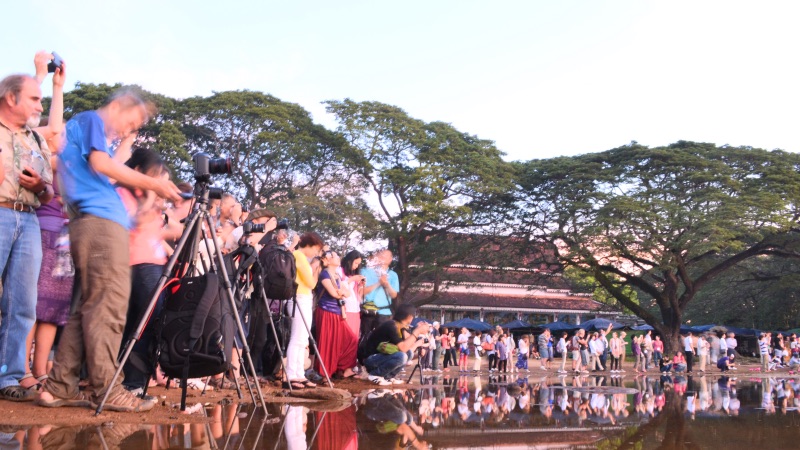
The most popular and iconic place to see the sunrise at Angkor Wat is directly in front of the main temple (west side of the temple). As you walk down the main pathway to Water Temple, you will see a couple of reflection pools where people gather to take photographs at sunrise. This is the most popular area to see the sunrise at Angkor Wat, and therefore it generally gets very crowded even if you arrived very early. So if you are planning to visit the main temple for sunrise, don’t expect a serene and tranquil experience; it is, however, very beautiful.

If you’re looking for a more tranquil and peaceful sunrise experience at Angkor Wat, we recommend exploring Srassrang Temple (Srah Srang), Bangheng Temple, or Prerup Temple (All of these temples are open as early as 5 am).
What is the best place to see the sunset at Angkor Wat

The most popular place to see the sunset at Angkor Wat is Bangheng Temple. This beautiful Temple is situated on a hill allowing stunning views over the flat plains of the Siem Reap district. It is often possible to see beautiful glowing sunsets, and on the clear day, you can see the sun sink below the horizon.

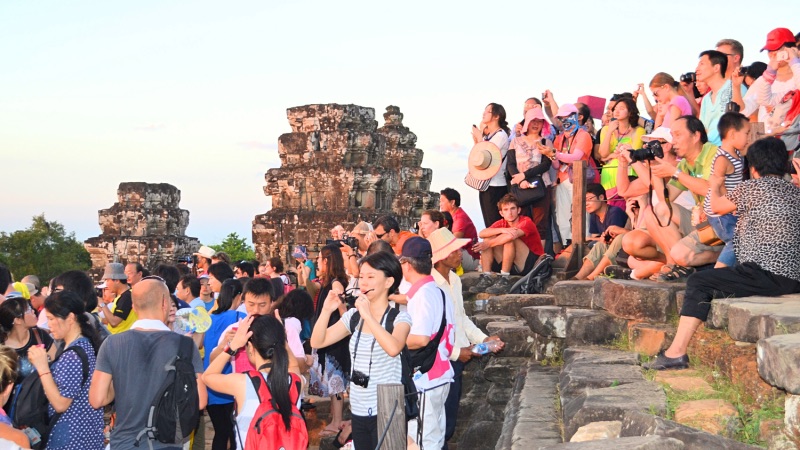
This is a very popular and iconic place to see the sunset, and it does get very crowded up here, so if possible, we recommend arriving early to get a good spot.
If you’re looking for a more tranquil and peaceful sunset experience, then we recommend a visit to Phnom Krom. This is a beautiful Temple Hill located to the south of Siem Reap. You will need to arrange this with your driver, and it is likely to cost a bit more.

This hill is situated around 45 minutes from the Angkor Wat complex. Set off nice and early if you want to see the sunset here. You need to use your Angkor Wat pass to access Phnom Krom, so you do need to do this on the same day as your main Angkor Wat trip.
Is Angkor Wat a religious site?

Yes, Angkor Wat is a site of religious significance, although it was not originally constructed as a Buddhist temple. It is now recognized as a site of spiritual significance to local Buddhists. You will often see local Cambodians visiting Angkor Wat to bring offerings, light incense, and to meditate. You are also likely to see Buddhist monks in the area.

If you are visiting the Angkor Wat complex, you do not need to be concerned about religious or cultural rules. For example, if you are just walking around the Angkor Wat building, there is no specific dress code. However, if you want to visit the Central Tower of Angkor Wat, there is a Buddhist Shrine, and you will need to make sure that your shoulders and knees are covered. We recommend bringing a scarf if you are hoping to explore inside the Angkor Wat temple buildings.
Can you buy food and drinks at Angkor Wat?
You can buy food and drinks at Angkor Wat; however, the range and choice are relatively limited, and food and drinks are also quite expensive in Angkor Wat. A simple meal is likely to cost around twice the price of an equivalent meal in Siem Reap. There are several cafes and restaurants around the Angkor Wat complex, including a small cafe situated next to the main Angkor Wat temple. You can also see lots of locals selling snacks and drinks around the Angkor Wat complex. We recommend bringing plenty of drinking water with you because water is relatively expensive in Angkor Wat (locals may try to charge $2 – $3 for a large bottle of water). Remembering it’s completely acceptable in Cambodian culture, and we do recommend bartering for food and water in Angkor Wat.
Is Angkor Wat accessible to wheelchairs and prams?
Many areas of the Angkor Wat complex are accessible to wheelchairs and prams; however, if you are hoping to explore inside the temple buildings, then you may struggle with a wheelchair or a pram. Most of the temple buildings are only accessible by steep and uneven staircases, and this could be challenging even if there are helpers available. If you are traveling with a baby, we do recommend using a sling or a baby carrier rather than a pram. If you are visiting with a wheelchair, we recommend planning an itinerary that allows you to appreciate the temple buildings by finding viewpoints around the temples. Many of the temples are surrounded by roads and footpaths which allow you to get very beautiful views and photography without needing to enter the building itself.
