

Table of Contents
If you’re visiting Thailand in 2026 you will probably have a list of loads of places you want to see and lots of things you want to do. What is the CHEAPEST transport in Thailand in 2026?
Local transport in Thailand may be one of the biggest things you need to consider when you are planning your trip to Thailand.
But how do you get around to make sure you see everything and don’t blow your budget? Covid has only made travel more tricky and this is very true in Thailand. Many places have limited or suspended public transport services, making it challenging to get around. But don’t worry there are still great options and it is still possible to travel around Thailand on a budget.
There are loads of options with different prices and advantages. It can feel a little overwhelming to know where to start. Don’t worry we’re here to help you join the dots in your awesome holiday plans. In this guide we focus on short journeys – getting around your local area. Between cities and provinces you will need to consider long distance buses, trains or flying. In this guide we will also update you on recent changes to travelling in Thailand. So if you’re planning a trip to Thailand this guide will be essential for you…
ALSO don’t miss our FULL BREAKDOWN – what is the cost of a Thailand trip?
How has transport in Thailand changed since the covid pandemic?

Travel in Thailand has changed a lot in the past couple of years. Travellers and locals are now more concerned with hygiene and safety. It is essential to wear masks in taxis, buses and tuk tuks. With the effect of the covid pandemic and increased use of the internet for services, things are very different now…
Change 1: Local buses are disappearing – Public transport in Thailand is much more limited

Public transport in Thailand has always been hit and miss. Now many public transport services are even more limited or entirely cancelled (this is mostly affecting buses rather than trains). It is now not possible to plan a budget Thailand trip relying on buses for local travel. Also remember we’re talking about short distance local travel here. Long distance buses are still running but some companies may have restrictions for foreigners using their services.
Change 2: Shared taxi buses and tuk tuks are disappearing

In the past you could find small shared taxi buses (sometimes called Songthaews). They are somewhere between a taxi and a bus because they would run a regular route and charge lower prices compared to a taxi. You would still need to barter a little but this was a cheap and convenient way to get around in Thailand. More recently these taxi buses are much less common (perhaps due to covid and apps). When you do see them driving around they may be willing to stop for you but they will normally try and charge private tuk tuk prices (expensive!) and may well take a different route to deliver you to your destination.
Change 3: Many people are moving to Apps for local transport in Thailand

The Grab App is SouthEast Asia’s answer to Uber. Grab is the main app in Thailand for taxi services (and they also do food delivery too).
Don’t miss our guide on how to GET THE BEST PRICES on Grab in Thailand
Most taxi drivers are now set up on Grab- and if anything this has helped their business not hindered it. However, some locals looking to make a buck or two have also registered to use their own cars as Grab taxis. And you will also find lots of minibuses are registered with Grab. The great thing about using Grab as a foreigner is that you will pay the same price as any local using the service, and you know what you need to pay – there is no ambiguity – drivers just stick to the price and to the route.
Grab has impacted some drivers negatively. Taxis that are not registered on grab now don’t have as much business and so the competition between drivers is higher. You might think this would lower prices but it seems to have done the opposite. Many tuk tuk and taxi drivers try to charge more if you flag them on the streets. Many tourists are also happy to pay this to support locals and will not barter on principle. We totally respect this. However, we also recognise that some travellers will be on a tighter budget – so don’t feel bad if you do need to barter or shop around.
There is an even cheaper taxi app that works in SOME areas of Thailand called Bolt. This app offers lower prices on average BUT it can be a little slower, less reliable and is less wide-spread. You can actually use BOTH apps simultaneously. If you’re looking for the cheapest taxi check the prices on each app. If you’re in a rush search for taxis on both apps and then cancel the search on the slowest app. This savvy Thailand travel at its best.
Comparison of the main methods of transport in Thailand

Here is an overview of the main types of local transport in Thailand. We haven’t mentioned walking, running and cycling. If you can get around on your own steam this is always great for health and budget but can take a long time. For some islands in Thailand this may be your only option.
For most cities, islands and tourist spots it is just a bit too far to walk between places, so you will need to consider your other options. Also many people find the heat too intense for walking. Here’s a super useful (and slightly geeky) summary of the main ways to get around and their advantages and disadvantages:
| Advantages | Disadvantages | Rough prices | |
| Local bus | Super cheap, fun, great way to experience local life. Environmentally friendly option. Most extensive service in Bangkok. | Bus routes and info can be hard to find. In some places buses are irregular or non-existent. | 10 baht – 100 baht should get you around most places (20p – £2 or $0.3 – $3) |
| Bike taxi | Cheap, fun and convenient transport in Thailand. | Can be risky. Not always easy to find. Need to barter. Hard with bags. Not great in the rain. Not great for long distances. | 50 baht to go 5km(£1 or $1.30) |
| Grab taxi (car and sometimes minibus) | Very convenient especially if you have data on the go. Pretty cheap too. No need to barter. You pay the same price as locals and everyone else. Can carry a group or family. | Not available in some locations or times. May need to wait for a good price taxi. Advanced bookings expensive. Relies on data on the go. No baby seats. | Around 100 baht for 5km depending on area and demand(£2 or $2.60) |
| Roadside taxi or tuk tuk | Quite convenient (less now because of Grab). Tuk tuks are a lot of fun. | Expensive, need to barter. Drivers can be intense. No baby seats. Generally pay a lot as a foreigner. | Can be 300 baht or more for 5km(£6 or $8) |
| Bike rental | Widely available, very cheap and a lot of fun. One of the best options for local transport in Thailand. | Can be risky – on the roads. Need a license. Not great in the rain! Not suitable for big bags. Not great for long distances. Need to navigate yourself. | 200 baht per day + petrol(£4 or $5) |
| Car rental | Convenient – will normally drop cars off at your hotel. Can often get baby seats (may cost a little extra) | You are responsible for the car (expensive). Need a license. Need to navigate yourself. | 800 baht for one day + petrol. (£16 or $20) 500 baht per day for longer rental periods (£10 or $13) |
What is the cheapest transport in Thailand? (for short journeys)
The cheapest and best transport in Thailand depends whether you are travelling as a solo, couple or family, how far you plan to travel and how many journeys you plan to take. It also depends on how much you value convenience and how long you have for your journey. And as ever, the price depends on whether you use super clever bartering skills to get the best deal.
Top tip: Some hotels may offer a free shuttle service to local destinations. If you are planning to explore the area around your hotel a lot this is worth checking out!
What is the cheapest transport in Thailand for solo travellers and couples?
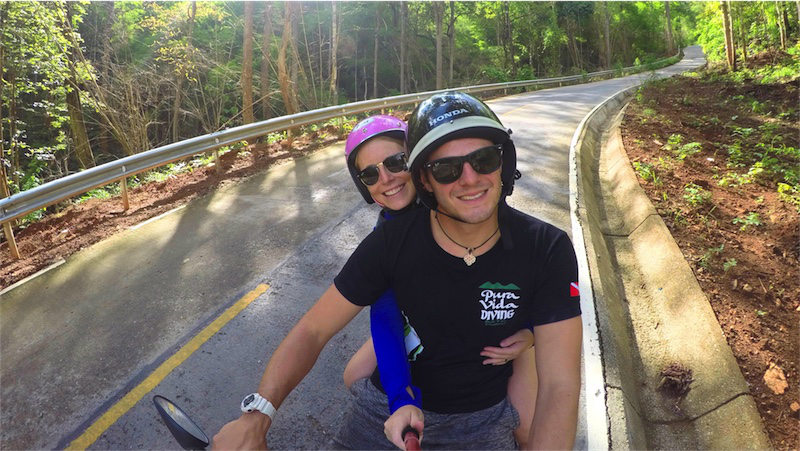
The cheapest and most versatile transport in Thailand is motorbike rental. There are loads of places to rent motorbikes in Thailand – especially in tourist spots. You can generally find motorbike rental for around 200 baht per day (£4 or $5) plus petrol. You can also arrange cheaper rental deals if you plan to rent for longer. Petrol is super cheap, normally costing 30-40 baht per litre (60p – 80p). Even if you do a lot of driving in one day it is unlikely that you will spend more than 100 baht (£2 or $3) on petrol. We only recommend bike rental if you feel confident in your skills, you are appropriately qualified and your insurance covers you for riding a motorbike. Always wear a helmet – safe is the new cool!

For longer distances (over 15km) bikes can get a little uncomfortable. If you’re going longer distances as a solo traveller or couple and you don’t mind paying a bit more – then a Grab taxi may be the best option for transport in Thailand. Also if you have bags to move around or if you’re travelling during rainy weather, we recommend considering a Grab taxi.
What is the cheapest transport in Thailand for families and groups?

The best and cheapest transport in Thailand as a family or group will depend on how far you want to travel in a day and how many stops you plan to take. If you only have a few journeys and you aren’t travelling too far, taking a Grab Taxi will be your best option. If you have many journeys or you are planning to travel a long way then consider car rental.
As a rough guide, if you are planning to travel more than around 50km in one day (especially if there are several stops) you will probably find that car rental becomes cheaper and definitely more convenient. If you are planning several longer days of travel, car rental is likely to be cheaper because you can often negotiate great longer term rental deals. Rental prices drop from around 800 baht (£16 or $20) for a single day to 500 baht (£10 or $13) or less for longer term deals. Don’t forget to factor petrol costs into your planning.
Example of total car rental prices for transport in Thailand
We rented an average size car for one week in Phuket at a cost of 500 baht per day. Rental cost 3,500 baht for the week (which is around £70 or $100). We did loads of driving every day (averaging 50km or more per day) and had to fill up a couple of times in the week. In total we spent around 2,000 baht on petrol (this is around £40 or $50). In total for the week car rental cost 5,500 baht or £110 including petrol (this is around $140).
A similar amount of travel using a cheap taxi would have cost around 7,000 baht (£140 or $160) and not been as convenient. The difference is not big but hopefully this will give you a feel for when car rental becomes the best value for money in Thailand.
So there is no quick and easy answer to the question of the best and cheapest transport in Thailand. Each method of transport in Thailand has its own advantages and disadvantages and the price depends on where you want to travel, when you want to travel and how far you want to go. Hopefully this guide has helped you understand some of the big changes in travel in Thailand in recent years. Happy travels and don’t forget to wear a helmet!
If you are planning a trip to Thailand – don’t miss our FULL one Week Phuket holiday itinerary.


