
Table of Contents
What is worldschooling? In this article we will introduce worldschooling and tell you everything you need to know to give it a go.
There is an exciting trend of families moving towards homeschooling and worldschooling in 2026. As two teachers in a former life – we are now world schooling our two beautiful boys. It has been a real journey and education for us. We have learned so much doing this – and we are super excited to share it with you.
“Education is an adventure and the world is an education.“
In this article we aim to answer all of your questions about worldschooling. What is world schooling? How is it different to homeschooling? How is it similar? What are the challenges and rewards of world schooling? What curriculum and resources are out there? Can anyone world school? Is it better for different ages?
You may also be interested to learn more about the advantages and disadvantages of worldschooling
What is worldschooling?

World schooling is an innovative and emerging way of learning, teaching and understanding. World schooling is about travelling around the world and using experiences and activities to promote a child’s learning, understanding and skills.
This type of education is not limited to one country or region, but can happen anywhere in the world. The goal of world schooling is to make sure that children have access to resources from all over the world so they can learn different skill sets, techniques, and cultures.
What is the philosophy of worldschooling?

The world schooling philosophy is centred on experiential learning which aims to promote self-discovery, empathy, and a sense of responsibility in children. The idea is that students learn best when they are exposed to a variety of stimuli, experiences and activities.
Can anyone worldschool?

Yes and no. There are no formal requirements to worldschool. If you’re willing to give it a go and learn along the way anyone can worldschool. However, an innate component of worldschooling is a sufficient amount of travel, variety and intentional experience. So realistically world schooling is only a viable option for families that are able and willing to travel with children for enough time to create some learning opportunities on the go.
As worldschooling parents and teachers we’re excited to share our top tips for worldschooling with you. Most parents prefer to world school younger children – this is a good age to worldschool – children are more open minded and absorb new experiences in an exciting way. Parents also tend to feel more equipped to direct, guide and input into a younger child’s learning. As children get older the need for specialist input, formal assessment and independent learning increases.
How do you start worldschooling?
There are many things to consider before worldschooling. You will need to think about resources, curriculum, style, structure. What will your child learn and where will you go? If your child is currently enrolled in a school you will need to go through all the admin and procedures for transitioning to education overseas. This is likely to involve conversations with the school and your local education authority. We are definitely not trying to put you off. Worldschooling is an epic adventure and has plenty of advantages for your child and for your family. But we’re not pretending it’s easy.
EARNING ON THE ROAD? Don’t miss our FULL GUIDE to the BEST & Most Affordable countries for Digital Nomads
What are the similarities between worldschooling and home schooling?

Worldschooling is very similar to homeschooling. A parent or both parents are generally the primary educator. There is a flexibility to pick a curriculum that suits you and your child (or no curriculum at all!). As parents you can set the pace, goals and respond to the needs of your child on a one to one basis. In both homeschooling and world schooling the pace and progress tends to be faster than education in a traditional classroom (again it is one-to-one).
What are the differences between worldschooling and home schooling?

There are lots of similarities and differences between homeschooling and worldschooling. Being aware of these differences can help you grasp worldschooling more fully. The main differences between world schooling and homeschooling:
| Home schooling | Worldschooling |
| Can use bulkier resources (musical instruments, science equipment, | More new exciting opportunities – Every location presents a chance to learn |
| Easier to join networks and find social opportunities for children | Greater variety of experiences to learn from and reflect on |
| Stability and consistency of the same environment | Opportunity to develop wider range of adventure skills (free diving, skiing, mountaineering) |
| Consistent local resources (libraries, parks, fitness centres) | More enriching cultural learning opportunities. History, religion, culture, politics |
| Consistent access to local clubs and activities | Cross-curricular learning very natural – transition between subjects easily and naturally |
| Can have a bigger range of physical books and textbooks | Chance to meet and interact with a wider variety of people |
| Easier to record and store children’s work | Most work and books need to be digital. Less face-to-face support – so need to be more independent |
What are the challenges and rewards of worldschooling?

World schooling is remarkably rewarding and effective. THE WORLD becomes a child’s classroom – and what better classroom than that? Every new experience and every new encounter provides a novel and memorable learning opportunity. Learning is innately holistic – children learn knowledge, skills and also have opportunities to develop their character.
The main challenges of world schooling
- Consistency and moment can be challenging if you are traveling fast
- Lack of equipment and physical resources can be challenging (e.g. sports equipment, science equipment and musical instruments)
- It can be hard to find social opportunities – although it can also be easy
- Children can sometimes be over excited and over stimulated by new environments and find it hard to focus (but this comes with practice)
- It can be hard to find more structured extra-curricular activities (such as sports clubs)
- It can be hard to record a child’s work and progress
- Greater need for digital resources and work
- Lack of formal support and advice – can be more tricky to assess children’s work – especially older children
Examples of worldschooling opportunities
Don’t miss our guide to THE BEST worldschooling resources
The best way to understand worldschooling is to consider some of the awesome unique oportunities for learning. Pack pens, sketch books, note books cameras and a but load of snacks.
Here are just SOME examples. The world is a giant classroom – and with some creativity and planning – almost anything can become a learning opportunity for any age. Any of these activities could be differentiated to any age group of ability level.
1 Visit a museum or gallery

Most cities have museums and gallaries. This provides unique and enriching way to learn about history, culture, art and science. Galleries and museums tend to be relatively affordable around the world – and with some careful planning and the right structure, these can make very meaningful learning environments for worldschooling.
2 Explore science in a swimming pool

Some countries allow fast, easy and convenient access to swimming pools. This provides a perfect opportunity for some creative investigative science. You could drop pebbles of different sizes to see which hit the bottom first. Make paper boats. Explore buoyancy. Investigate sounds under water and much more.
3 Investigate biodiversity in an ecosystem

Wherever you are in the world, hunt out some beautiful wilderness and investigate a local ecosystem. Watch out for plants, insect, animals. Explore concepts like population, predations, competition and feeding relationships in the ecosystem. Measure trees and plants. Observe leaf sizes, shapes and root structures. Learn about the wild. Use an app like Seek by iNaturalist to use AI to identify species around you. Keep a journal, research, write, draw and record. There are so many different ecosystems to explore and experience. Rock pools, ponds, woodlands, meadows, jungles, coral reef.
3 Read local literature and learn about the culture

Why not grab some local literature and learn about the culture. Perhaps you could find a novel and learn about a period of history in the culture. Alternatively grab a modern publication and learn about what is happening now in the culture.
4 Learning a new skill or sport

Worldschooling offers an exciting and diverse range of sports and skills. Whether it is rock climbing, free diving, sea kayaking or mountaineering. There are always epic sports and skills that children can learn. This is perhaps one of our favourite things about world schooling. On the other hand, access to sports teams and coaching may be a challenge for worldschooling. Your best bet is to find an international school and see if they have extra-curricular activities your kids can join.
5 Climb, trek, explore and challenge yourself

Climb a mountain, find an epic trek, try wild camping and find adventures that push your limits. This is something that develops character, grit and perseverance. Something that traditional education systems are not good at.
6 Get involved in a charity or humanitarian project

A massive part of holistic education is learning how to help. Find a compassionate humanitarian project to support. Volunteer and learn new skills. Perhaps it is paining wooden homes in a Cambodian village. Or perhaps it is volunteering to read in a local rural school. Or perhaps you will help with a homeless feeding project. There are also lots of awesome wildlife projects you can help with.
7 Learn a new language

Make the most of language barriers. Use it as an opportunity to learn a new language together. Immersion and context is one of the best ways to teach a new language – and what better way to excel when every interaction is part of teaching you the new language. This is also a great way to connect with and show an interest in the local community.
8 Calculating journey distances and times

Physics is one of those subjects that is constantly “happening around us”. Why not practice calculating distances and journey times. For example, you may know how far a train journey is and how long it will take. Your child can calculate the average speed (it’s just distance divided by time). More advances learners can also practice calculations like this with different units or even acceleration calculations.
9 Mathematics with a new currency

Using a new currency is a great way to practice quick arithmetic skills. Whether it is work out how many coins to pay with, work out what change to expect – this is a great way for quick addition and subtraction. Alternatively try converting currencies and study exchange rates. Maths really is an invaluable subject.
10 Investigating physical geography

This picture is from sticky waterfall in Chiang mai. The unique surface crystals on the bed of this waterfall form a suprsingly high friction surface that you can walk up. There is loads of epic science to learn here – and it’s loads of fun too.
Watch out for interesting local physical geography. Whether it is mountains, volcanos, canyons or hot springs. Make the most of learning physical geography from the earth itself. Visit a waterfall. Measure water flow rates. Study plunge pools and waterfall formation. Study how rivers flow and meanders. Study different types of lakes and cliffs. Watch out for things like caves. Learn about what the earth has to offer and consider how you can integrate this into your child’s learning.
11 Take a local cooking course

You may thing that domestic skills like cooking are hard to teach in worldschooling. Why not sign up for a cooking course? Lean about local spices and ingredients and learn how to cook local dishes from local chefs. In some countries you may also have easy access to cheap ingredients and kitchens. Perfect for consolidating cooking skills.
12 Visiting a farm or spice garden

Watch out for things like farms and special gardens. Learn about crops, agriculture and local food production. In Penang we loved learning about tropical fruits at the Tropical Fruit Farm. There is also a spice garden nearby. Wherever you are in the world, you will probably be able to find place like this to visit.
13 Get involved in a conservation project

Why not find a conservation project? It could be an animal sanctuary. Or perhaps there are innovative projects like trans-location projects. Or why not get involved in a re-forestation project. Find ways to learn about and conserve our natural resources. Much better to actually DO this than learn about it in some abstract theory lesson.
14 Interview a monk or religious leader

Why not visit local heritage sites. Perhaps you could chat with a local religious leader to learn about the beliefs, values and religions of a culture. This could be consolidated by further learning and studying the history, beliefs and practices of local religions. Observe how religions, culture, dress and food practices change from country to country.
What are the best worldschooling curriculum?

The best world schooling curriculum is not a single standardised curriculum. Instead, it is a range of options that are tailored to the needs of the individual student’s home country and culture. With the new trend of world schooling, there is no single standardised curriculum.
IGCSE, MYP, SATs, A-levels and IBDP are some of the most popular international curricula in the world.
Charlotte Mason
Charlotte Mason is a British educator who advocated for the importance of children learning through experience and nature.
Charlotte Mason’s approach to education is often called the “Mason Method”. She believed that children should be given an education that was “wholesome, natural, and complete”. Children should learn through their own experience, reading books and being exposed to nature as much as possible.
The Charlotte Mason approach emphasizes the importance of a child’s natural development in all areas of life: physical, intellectual, emotional, moral, spiritual and social. The curriculum is designed to foster these aspects of development by emphasizing what they call “the seven Rs” – Reading (of good literature), ‘Riting (of good composition), ‘Rithmetic (of good numbers), Recitation (of poetry), Reflection (of self-analysis), Representation (of art work) and Recreation (in healthy play).
IGCSE (14 – 16 years old)
The Cambridge IGCSE curriculum is designed to prepare students for university education in England and Wales as well as other countries which recognise this qualification. IGCSE is the international equivalent of a GCSE (and is actually a little more rigorous). IGCSE is an international qualification offered in over 100 countries that can be studied from Year 9 to Year 13 in secondary schools. It takes six subjects: English language, mathematics, science (either biology, physics or chemistry), a foreign language (French, German or Spanish), history and geography.
IB MYP (11 – 16 years old)
The IB (international baccalaureate program) is one of the most widely recognised and prestigious international education programs in the world. They offer a PYP (primary school curriculum), an IB Middle Years Program (MYP) and the IBDP (diploma program) for 16-18 year olds. The MYP is an international curriculum for students aged 11-16 years old which covers a broad range of subjects and skills that are taught through project work, inquiry learning and creativity. The MYP curriculum is an international programme which prepares students for university education worldwide by providing them with a comprehensive general education at secondary level that includes humanities and sciences as well as languages (English), mathematics, art and design (or theatre arts) and physical education. It is worth adding that the IB course normally needs to be delivered by an accredited school or college. But there’s no reason a world schooling family can’t base their learning on the IB curriculum.
A-Levels (16 – 18 years old)
A-levels are internationally recognised qualifications offered by universities across England, Wales and Northern Ireland which require students to study three or four subjects at advanced level with each subject lasting. The Cambridge exam board offers International A-levels. Again these are more challenging than the non-international equivalent.
AP (16 – 18 years old – US equivalent of A-levels)
The American AP program is a post-16 academic qualification in the USA. It is equivalent to the UK A-level.
AP courses are challenging and there is a lot of work involved. Students are required to study subjects such as science, maths and English, which are traditionally difficult for students. However, with the right help and support, it is possible for students to succeed in these subjects.
Textbooks for world schooling curriculum
Textbooks and resources are often required for these curricula. These textbooks can be expensive to buy or can take up a lot of space in the classroom. Many publishers now offer digital textbooks – perfect for world schooling families with limited space in their backpacks!
Tips for worldschooling an SEN child

This section will provide you with tips on how to world school a SEN child (Special Educational Needs). The idea of Worldschooling and SEN child may seem scary and overwhelming. In many ways world schooling is very well suited to a child with special needs.
The most common types of special needs are dyslexia, Autism and ADHD. The first step in supporting a child with SEN is identifying their needs. There are formal testing processes to get a formal diagnosis. Alternatively, you can observe your child learning and watch out for their own challenges. This is not about “sticking a label on your child”. Rather it is about getting to know them and their personal challenges. Being sensitive and patient with their personal challenges and finding gentle tools and techniques to support them and better promote learning.
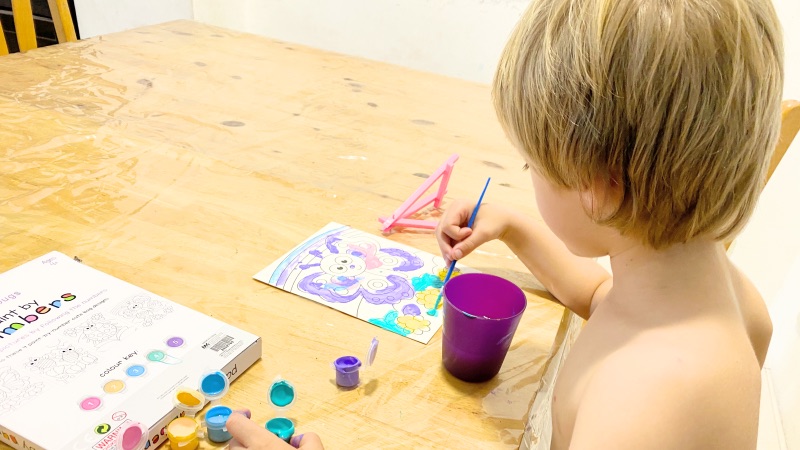
SEN children often have difficulties in school. This can make it hard for them to keep up with the rest of the class. The advantage of world schooling is that you can give your child the one-to-one attention and support that they need. The visual and kinesthetic experiences of travel can be ideally suited to some SEN learning profiles. Worldschooling is innate holistic which makes it an excellent educational model for many students.
It is important to be aware of your child’s specific needs and strengths. There are many ways you can support your SEN child while they are worldschooling. You can use tools like Dyslexie to help them with their reading and writing skills, get them an iPad for taking notes and recording their experience, or find an online school that offers a one-on-one tutor service.
There are many resources available online that can help you support a SEN child while they are world schooling.
A day in the life of a worldschooling family in Vietnam
Don’t miss our guide to THE BEST family travel blogs
50 AMAZING family travel blogs to follow
